- Nov 29, 2025
How to Reach French Fluency at Home: The 4-Step Active Immersion Method
- Julie Lecomte
- tips to learn French
- 0 comments
You don’t need to move to Paris, quit your job, or spend two hours a night drilling grammar tables to become fluent in French. In fact, most intermediate learners stay stuck for years simply because they rely on passive listening and endless app streaks instead of an active immersion strategy.
Whether you are an expat working in a Francophone country or studying remotely, here is the proven 4-step framework to unlock real-life French fluency from your couch.
Key Takeaways:
Step 1: Pick the right content. Use podcasts and articles where you understand about 80%, rather than getting lost in native TV.
Step 2: Speak a little every day. Read out loud for 10 minutes or describe your daily routine to build speaking confidence.
Step 3: Spot grammar in real life. Stop doing endless fill-in-the-blank drills; notice how grammar is actually used in real French media.
Step 4: Practice actively. Write down new words and use them, shadow native speakers, and get real feedback through live conversations.
Why is immersion the key to reach fluency?
First and foremost, at the intermediate level and if your goal is to speak fluent French, you absolutely need to create your own immersion in the language. And surprise, you DON’T need to move to Paris nor Nice! I have countless examples of students who were fluent in a language and learnt it on their couch. In this instagram reel, I was explaining that listening to French people talking at the bakery is far from being enough if you’re serious at learning French.
You might have heard this immersion advice many times but do you know why your exposure to the French language is such a key factor for reaching fluency in French? Think of yourself as a computer or even an IA machine in training. Before being able to speak, you’ll need to feed your bank of French vocabulary, grammar and sounds massively. This input will allow you to first, understand written and oral French and second, to speak and write French properly. To understand this, have a look at this figure which explains the process of language acquisition :
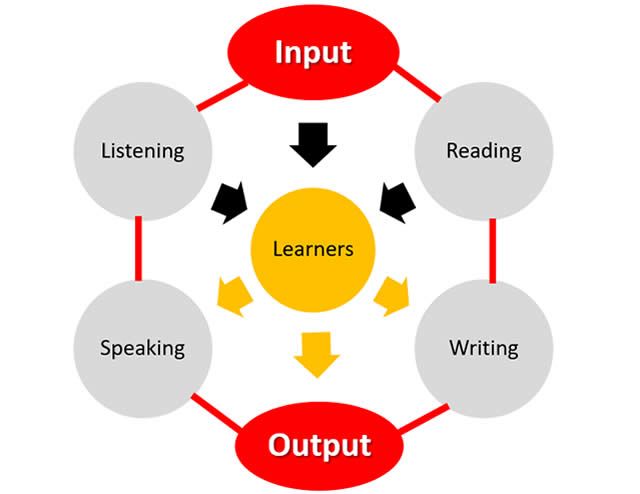
Source : Input And Output In Second Language Acquisition: Understanding Key Concepts
How to choose the content to immerse yourself?
Choose a variety of resources that you enjoy.
By this, I mean, you might have been told to read books most of your school years. True, reading helps a lot when you want to learn vocabulary but yet, if you don’t like reading, you will give up soon. Think of what you enjoy listening to in your mother tongue or other languages you speak. Nowadays, there is literally no excuse as the internet is full of content of any language. At an intermediate language learner, my favourite resources are podcasts created by teachers and news articles or posts in socials as they’re short. If I’m more advanced, I switch to series and books. It can be hard to select or know what’s available in French, that’s why I created for you a special Guide : Ton immersion en français so you can pick good quality content according to your level and follow the right strategy to learn French efficiently. Yes, in this Guide, I explain what’s the difference between passive and active learning. Don’t miss out if you want to know how to speak French fluently faster!
Choose something slightly above your level.
Ideally, you should be able to understand 75-80% of the piece of content you’re reading or listening to. That’s comprehensible input and is key for you to really intake : “The input is the potentially processable language data that are made available, by chance or by design, to the language learner. That part of input that has actually been processed by the learner and turned into knowledge of some kind has been called intake.” (Sharwood Smith (1993) Same source as above.
Different ways to practise speaking
Now, say you read and listen to French regularly, your understanding is getting better and better, that’s great. However, you can’t ‘Netflix and Chill’ too much! Nowadays, most courses claim that you’ll speak French from day 1. It’s true that practising speaking from the beginning is very important. Generally, in a big classroom, you don’t have much time though to speak. When you’re intermediate or advanced, it’s even more important to find a way to speak and unlock your fluency. Here is my advice.
Read out loud
An activity that’s unfairly overlooked is reading aloud. You remember your school years when you had to read out loud in front of the classroom? Dreadful right? In fact, this activity is beneficial at any age. It allows you to actively engage with the content you’re reading, retain it better and of course, in our case, practise your pronunciation and improve your fluency in French. Most polyglots do it and I bet you’ll benefit from it too. You can read aloud short texts as news posts on socials, extract of books and even lyrics of songs.
Talk to yourself and / or your pet
The key to reach fluency is practising regularly and again, any occasion is a good occasion. Having a little chat to yourself in French when you’re alone is great practice! You’re alone, feel comfortable to make mistake, correct yourself if you can! Comment on your daily activities, put out what’s on your plate and be your own psychologist! Some of my students enjoy speaking French with their pets as they’re very good listeners, rarely interrupt and don’t judge. I do talk to my dog in Portuguese and it helped me being more comfortable.
Talk to people (even if it scares you)
Finally, the most motivating and rewarding activity is to talk to people in French. Some intermediate and advanced students are anxious when moving to a francophone country and wonder if they are going to be able to communicate. The best is to get ready before your moving.
If that’s your case, I highly recommend taking 1:1 or group lessons with a teacher who will guide you and correct you. Some courses now focus on developing fluency and nothing beats the guidance and feedback by a trained professional. I invite you to join the group course En Immersion.
Other good options are:
Joining a French conversation club or a francophone club in your city. You’ll find those on the website Meetup if you live in a big city.
Finding a language exchange partner online (use the platforms HelloTalk or Tandem) or face-to-face (some libraries, bookshops and schools have a system that allow this).
If you already an expat in a francophone country and struggle to speak in French regularly because you don’t need to work in French or people you interact with are English speakers, these options are also great. Every time I lived abroad, I had to do this to get going and it allowed me to make friends while improving my skills.
Are grammar exercises useful to speak fluent French?
Grammar drills, a waste of time?
Sorry to disappoint you but if you spending most of your energy on grammar drills, you’re wasting your time and won’t be able to speak fluent French any soon. I don’t mean these are completely useless. It’s important to be able to speak correctly, understand key grammar rules and fix recurring mistakes but it’s not this that will most move the needle regarding your fluency goals. As a proof, I can tell you about kids who studied English in latin countries (I include France here), learnt languages the old way, with little exposure to the language, except reading tasks and plenty of grammar exercises. Result: most of them were not able to maintain any basic conversation in English after 6 to 8 years of studies. That was my case. On the contrary, those who became fluent listened to a lot of music on their own, watch films in OV.
What to do instead?
Don’t get me wrong, grammar drills are not totally useless. I actually recommend that if you’re a beginner, you should attend a structured group or 1:1 course to acquire solid foundations in grammar and basic French vocabulary. But once you’re intermediate (A2+ or B1 if you know these levels), you should focus on reading / listening to French and noticing the grammar (and vocabulary!) in the content you’re consuming. At pre-intermediate level (A2), most language courses already bore you with subjonctive and conditionals, right? When you’re intermediate, I reckon you should basically look for those structures in texts and audios you’re exposed to. That is truly the best way to acquire a language : notice, process, intake and repeat. If a concept is unclear, then ask a teacher, your fav’ grammar book or Google ;)
If you enjoy learning on apps, I recommend you Babbel. I used it to learn Portuguese and it was great. It’s really structured, makes you practise using the 3 key skills: reading, listening and writing, which enhances retention. Some of my students love Busuu. Just have a go at the free version and see which one you prefer. See, I’m not anti-grammar. I love it actually but I don’t want you to focus on it exclusively.
The difference between active and passive learning and why it matters
Okay so by now, you know how to immerse yourself in the French language and you have a few ideas on how to practise speaking. Is that enough? It can be, but to be able to speak French fluency faster, you need to understand the difference between passive and active learning.
What is passive learning and what’s wrong with this?
A common mistake I often observe with my students or international friends learning languages is exposing themselves to content without any strategy. This can work for some people but let me tell you they’re the exception. Yes, some learners might absorb rules, vocabulary, sounds and structure of a language ‘magically’ thanks to their natural abilities, the bridges they make with languages they already know or other factors. Yet, most of us will need more work and it’s normal. To learn any skill, you need to engage actively with the topic and repetition to hone your capacities.
What to do instead?
I recommend to my intermediate and advanced students have a routine to engage consistently with the French content they read or listen to every week. They can be passive or active but keep in mind the second will boost your progress and definitely accelerate your fluency in French. The aim is to spend some time every week working on your French so it helps your memorisation.
Here is your simple plan. Every week, plan a few activities you can do without a tutor passively or actively, depending on your time and energy:
Passively >> Actively
Listen to a French podcast while cooking >> Listen to a podcast with your notebook, take notes, check new vocabulary and grammar on the transcription (Spotify provides it now)
Read the news in French on socials / a French book during your time spent on the metro >> Read the news / this book aloud, write down new words and create your own sentences with the word
Put some French music while working out, driving, sing and enjoy it! >> Translate the lyrics of your fav’ French songs
Watch a Youtube video in French during your lunch break >> Watch a Youtube video activating the transcript and noticing colloquial expression; write them down on your notebook
Participate in a conversation club, following a formal course without taking any notes and not reading the vocabulary before the next class >> Be an active participant in these sessions, take notes, before the next session, read aloud and put the vocabulary on : to memorise it.
See the difference?
I hope you just got closer to your goal and that by now, you know how to speak fluent French. If you want to keep learning on this topic, I invite you to jump on my masterclass “Parler couramment : 3 erreurs communes” where I listed my students mistakes and mine while we’re trying to reach fluency in French. Hop on!