
- Aug 24
French Workplace Culture: The Complete Guide for Expats
- Fluent in French
- working in France
- 0 comments
Moving to France for work is exciting. But once the initial honeymoon phase wears off, you quickly realise that speaking French is only half the battle.
You see some of your colleagues “se faire la bise” (the famous double-cheek kiss) and others “se serrer la main” (shaking hands) in the morning. You carefully say “vous” to everyone, only to hear other people “se tutoyer” five minutes later. Meetings run long, lively arguments break out, and yet no decision is made before everyone heads off to lunch...
These quirks are all connected to French workplace culture—something I work through constantly with international executives in my private French lessons for professionals.
The good news? You don’t need to change your personality to thrive in France. You simply need to understand the unwritten rules of the game. Let’s break down what to expect, why French colleagues do what they do, and how to navigate your working life with confidence.
1. Where Does French Work Culture Come From?
French professional habits don’t just appear out of nowhere. They are deeply influenced by the French education system, institutions, and a long tradition of structured thinking.
The Art of Dialectical Debate
From high school through university, French students are taught to think through structured arguments. If you’ve ever written an essay in France, you know the famous dialectical plan: thèse, antithèse, synthèse (look at one side, explore the counterargument, then find a nuanced conclusion).
Those debate habits don't disappear at graduation—they follow people straight into the meeting room!
A Quick Story from My Past Life:
Before becoming a French teacher, I trained as a civil servant. Oral debates were a mandatory part of our curriculum! This might sound bizarre when you think that civil servants must comply with strict ethical obligations like neutrality, secularism, and obedience to the chain of command. But in France, structured debate isn't seen as rebellion—it’s considered the only way to test whether an idea actually holds water.
The Weight of Diplomas (les Diplômes)
Academic qualifications carry serious weight in France. Graduating from a prestigious university or a Grande École provides immediate credibility, especially in fields like engineering, finance, consulting, or public administration.
What I Noticed Living in the UK:
When I lived in the UK, I taught many professionals in the luxury industry working in Sales or HR who had degrees in totally unrelated fields like English Studies or Human Sciences. They were given an entry-level shot, proved their talent, and went up the ladder. Easy peasy! In France, that kind of career pivot is much rarer. Your initial diploma remains a big part of your professional identity.
While your actual experience and results matter once you’re on the job, your degree is often the key that unlocks the door in the first place.
The Love for Process
France has a long administrative tradition, which means companies love clearly defined responsibilities. People want to know: Who owns this decision? Who needs to validate it? What steps must happen first?
Yes, this can sometimes make French companies feel bureaucratic—and trust me, it’s also “à se tirer les cheveux” (a real headache) for French people too! But once you understand the approval chain, getting things done becomes much easier.
2. The Core Values Shaping French Work Life
To understand what your colleagues are doing, you have to understand the values driving their behaviour.
1. Expertise Over Showmanship
In many English-speaking workplaces, delivering a pitch with charismatic confidence goes a long way. In France, colleagues look for substance over showmanship. They want to see your data, understand your logic, and know you genuinely master your subject.
Confidence is great, but solid competence is what earns you long-term respect.
2. Intellectual Rigour (critique does not mean conflict)
French professionals love analysing an idea from every angle before accepting it. If a colleague questions your assumptions or points out a flaw in your deck, take a deep breath: they are not attacking you personally.
In French culture, putting an idea through the wringer is seen as the best way to improve it. If people challenge your proposal, it means they find it interesting enough to debate.
3. Work-Life Balance as a Social Value
In France, work is an important part of life—but it is definitely not the whole story. Family life, vacations, and personal time are treated as legitimate priorities, backed by strong labour laws (including the standard 35-hour workweek and the right to disconnect).
Late-night emails: Firing off messages at 10 PM isn’t automatically seen as dedication. Often, it just signals that your workload is poorly managed or that you don't respect boundaries.
Leaving on time: Heading home when your workday is done doesn't mean you lack ambition; it means you're efficient.
The exceptions: Fast-paced fields like corporate law, investment banking, or strategy consulting still work long hours. But as a general baseline, French work culture aims for long-term sustainability rather than burnout.
3. Communication Style: Directness, Debate, and Feedback
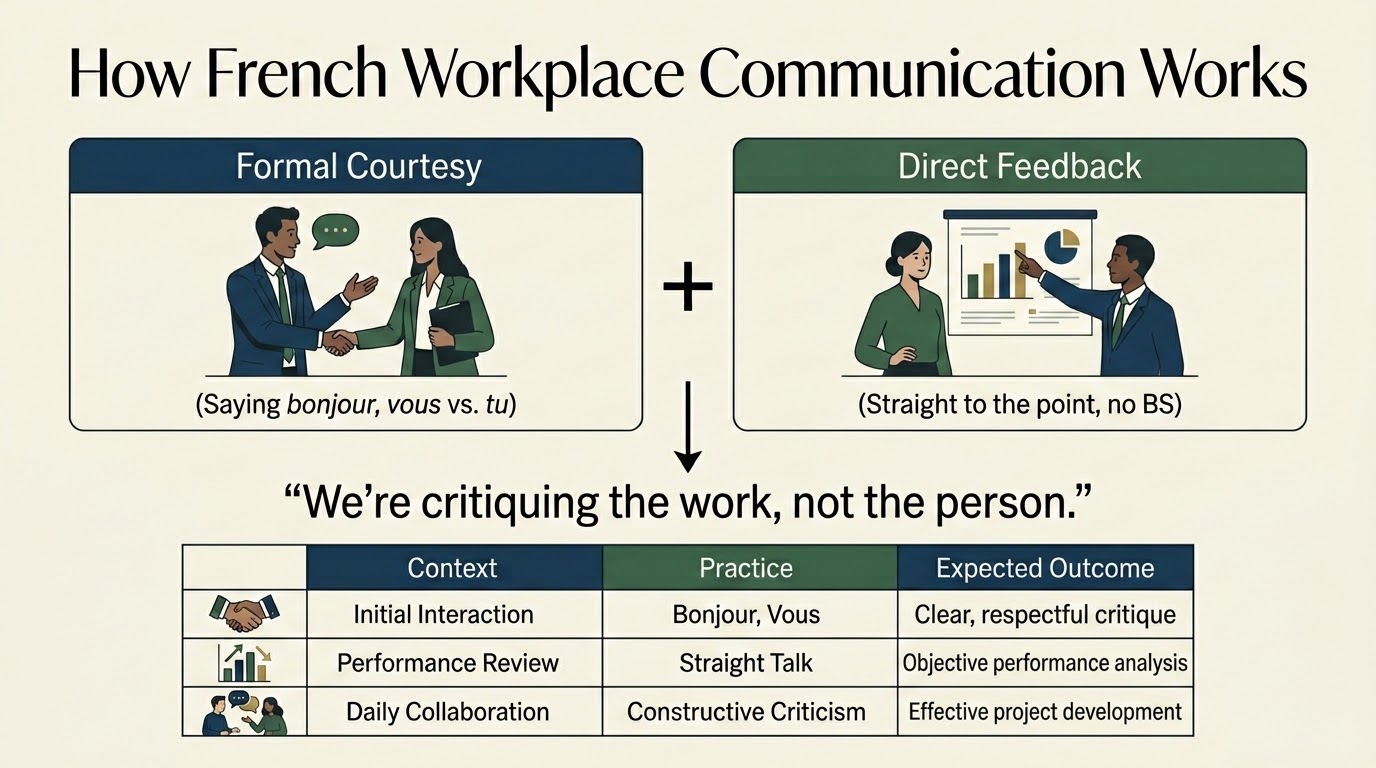
Communication is usually where expats feel the biggest culture shock. French professional conversation combines traditional politeness with surprising directness.
Why French Colleagues Sound So Direct
French business communication prioritises clarity over lengthy small talk. A colleague might simply walk up and say:
“Bonjour, tu as deux minutes pour parler du projet ?”
That’s not cold—it’s just getting to the point. When discussing deliverables, French colleagues rarely use a "praise sandwich" (cushioning a critique between two compliments). If a report is missing details, they will tell you directly: “Ce rapport n'est pas assez précis.”
A Lesson in French Directness:
French directness is so natural to us that we don't even realise when we're doing it! A few years ago, I drafted an email to inform my British students about a rate adjustment. To me, it was clear, polite, and straight to the point. My British partner read over my shoulder and was utterly horrified by how blunt it sounded! I had to rewrite the whole thing with three layers of gentle British padding. In France, you don't need all that cushioning—clarity itself is considered polite.
Debate Is Not a Fight
If someone says, “Je ne suis pas d'accord” (I disagree) or “Pourquoi tu proposes cette solution ?” (Why this solution over another?), don't panic. They aren't picking a fight; they are starting a discussion.
What I See in My Classes:
My British students often find this tough because they are culturally wired for diplomacy, understatement, and conflict avoidance. Meanwhile, my American students appreciate the directness, but get frustrated when meetings turn into passionate debates without an instant conclusion. In France, the goal of a debate isn't necessarily to "win"—it's to sharpen the final idea.
How to Handle Direct Feedback
Don't take it personally: Remind yourself that they are evaluating the document or process, not your intelligence.
Ask constructive follow-ups: Try asking, “Qu'est-ce qui manque selon vous/toi ?” (What do you feel is missing?).
Defend your logic calmly: Explain your reasoning with data rather than getting defensive.
Business Email Etiquette
French emails remain relatively structured, especially with clients or senior management:
Greetings: Stick to “Bonjour Madame Martin” or “Bonjour Monsieur Dupont” (or “Madame, Monsieur” if writing to someone unknown).
Sign-offs: Classic formulas like “Cordialement” or “Bien cordialement” are always safe.
Save casual sign-offs like “Bonne journée !” or “À plus” for close colleagues you chat with every day.
4. Hierarchy and Decision-Making
Is French workplace culture hierarchical? Yes, absolutely.
While there is plenty of lively debate in French offices, make no mistake: reporting lines and the chain of command (la voie hiérarchique) are taken very seriously. You can challenge ideas with your close teammates or your direct manager (le N+1), but you wouldn’t openly contradict top executives in a big company-wide meeting!
Here is how to navigate it like a pro:
-
Debate within your lane
What's really going on: You are expected to have an opinion and defend your work with logic and data. But respect the room: challenge ideas with your peers and direct boss, not by bypassing the hierarchy to argue with the big boss.
How to handle it: Back up your points with clear facts, speak up when your expertise is needed, and always keep your direct manager in the loop.
-
Decisions follow the validation ladder
What's really going on: Final decision-making power stays firmly at the top. Even if a brainstorming session goes amazingly well, the green light usually has to travel through several layers of management first.
How to handle it: Don't assume a great conversation equals a done deal! If you’re unsure whether you have the green light, simply ask: “Qui doit valider cette étape ?” (Who needs to sign off on this step?).
-
Independent thinking (with regular check-ins)
What's really going on: French managers hate micromanaging, but they also hate unpleasant surprises. They expect you to handle your day-to-day work independently while keeping them posted on key milestones and risks.
How to handle it: Don’t bring vague, open-ended problems to your boss. Instead, bring a structured recommendation: present the issue, offer two possible solutions with the pros and cons, and say: “Voici ce que je recommande” (Here is what I recommend).
5. Everyday Workplace Etiquette
Mastering small daily customs will accelerate your integration faster than technical skills alone.
The Golden Rule: Always Say "Bonjour"
Whatever you do, don't walk past someone in the morning without greeting them. Even if you're in a hurry, a quick “Bonjour !” acknowledges their presence. Walking into a room silently is seen as distinctly rude.
"Vous" vs. "Tu"
Start with vous: Use it with new clients, senior executives, and people you've just met.
Wait for the green light: When a colleague or manager wants to switch, they'll say: “On peut se tutoyer ?”
Embrace the switch: Once offered, use tu. Sticking with vous after being invited to tutoyer creates unnecessary distance.
The Greeting: Handshake or "La Bise"?
In formal business settings, a firm handshake is standard.
La bise (the cheek kiss) exists in many creative agencies, startups, or close-knit teams, but you don't need to initiate it. Watch what your coworkers do and follow their lead.
Dress Codes
Tech startups and modern agencies lean smart-casual.
Law firms, finance, and traditional consulting expect classic business attire.
Rule of thumb: When starting a new role, dress slightly smarter during your first week, observe your peers, and adjust from there.
6. Lunch Culture and Making Friends at Work
If you want to truly integrate into a French team, you cannot afford to skip lunch!
Why Lunch Is a Big Deal
In many countries, eating a sandwich at your desk while staring at a spreadsheet is completely normal. In France, that's practically a tragedy.
A Tale of Two Cultures:
When I worked in the French civil service, taking an hour for lunch together at the cafeteria or a local bistro was sacred. Later, when I moved to the UK, I had to travel directly into corporate offices to teach French to employees on-site. Walking through the open-plan floors and seeing people hunched over their keyboards, eating meal-deal triangle sandwiches all alone in front of their screens, I was genuinely shocked! In France, desk lunches are rare. Stepping away to share a real, sit-down meal is where colleagues bond, catch up, and unwind.
Lunch talk is rarely about deadlines or spreadsheets. Instead, people talk about weekend plans, food, holidays, and current events. Joining the table even occasionally will go a long way in helping you build real connections.
Networking the French Way
French professional relationships aren't built through aggressive, transactional networking; they develop naturally over morning coffees (la pause café) and shared lunches.
The "Decisions in the Hallway" Reality:
A student working at Eurostar once reached out for coaching because, while all their formal cross-border meetings were conducted in English, all the real decisions were made in French “dans le couloir” (in the hallway) right before and after the meeting! If you only speak English, you can deliver your slides, but you miss out on where informal consensus actually takes shape.
Even if your company operates officially in English, the kitchen jokes and hallway chats happen in French. Learning conversational French is your ticket to being part of the inner loop.
7. Your First-Month Survival Checklist
During your first few weeks, focus on observing the environment and building solid habits:
Say “Bonjour” to everyone when you walk into the office.
Default to “Vous” until someone suggests switching to “Tu.”
Figure out the chain of command: Learn who your manager reports to and who holds final approval power.
Join the team for lunch and participate in coffee breaks.
Don't take direct feedback personally: It’s about the work, not you.
Bring solutions, not just problems: Show you’ve thought through the logic.
Observe before changing processes: Understand why a system exists before suggesting a replacement.
Frequently Asked Questions
Is French workplace culture hierarchical?
Yes. While teams openly debate and critique ideas together during meetings, the final authority to sign off on budgets and projects stays with designated managers.
Why do decisions take longer in France?
French companies typically use multi-stage approval processes to manage risk and get input from multiple departments before locking anything in.
Can I get by if I only speak English?
You can certainly do your technical job in English at multinational companies. But if you want to understand office humour, connect with colleagues, and be in the room when informal decisions are made, learning French is essential.
What is the biggest mistake expats make at work?
Moving to informality too quickly. Skipping morning greetings, using tu without an invitation, or treating intellectual disagreement as a personal attack are the most common pitfalls. Start with polite structure, watch how others behave, and relax naturally as trust builds.
Navigating a new workplace culture takes time and practice. If you want to build your confidence, master business French, and communicate naturally with your colleagues, explore my private French lessons for professionals.